

Case Studies
Using a fully registered environment, ARtemis™ can blend any number of projectors into one seamless, high-brightness image that a whole group sees together. No headsets required. Displays across industries and markets can be large or small, static or deformable, front or rear projection, consumer or professional grade. ARtemis™ adapts to your hardware and your design team and takes the technical risk off the project.
Two museums
and a simulation training
California African
American Museum
Architectural walk through, a Summit system
Commercial Case Studies
Discovery Science Museum
(Los Angeles & Santa Ana, CA)
Projection-Based Immersive Experience
ARtemis™ drives a three-projector, 24' X 24' helicopter ride across the Southern California landscape. STL's push-button, computer-vision projection mapping cut recalibration from 4 hours (requiring a skilled technician) to 5 minutes (by the doorman).
Maintenance downtime has been virtually eliminated, and misregistration caused by heavy building harmonics is removed with auto-recalibration between shows.
"Holodome" by Vulcan and the Museum of
Pop Culture (Seattle, WA)
Domes | Immersive Experiences
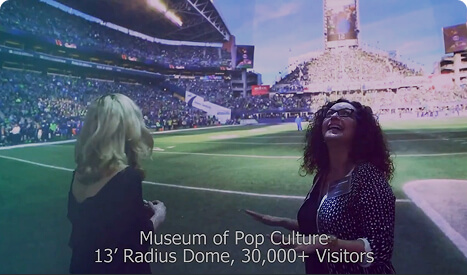
ARtemis™ powered the Holodome, Paul Allen's visionary project from Vulcan. Five projectors lit a 13-foot diameter inflatable, pear-shaped dome for a 360° surround display. Software from Scalable and VIOSO could not handle the large variations in the spherical shape, and the shape changed every morning when the dome was inflated.
Before working with STL to implement ARtemis™, they needed a skilled technician to spend 2–3 days (16–24 hours) recalibrating by hand. ARtemis™ reconstructed the dome's new shape every time it was inflated and projection-mapped it in 5 minutes from a push-button interface. No hand-on calibration required, making a transportable Holodome exhibit possible.
AlloSphere Media Arts Center
(UC Santa Barbara, CA)
Complex Surfaces | Mixed Hardware
The NSF-funded AlloSphere is a three-story, double-hemisphere media arts center at UCSB. Using ARtemis™, it became a first-of-its-kind immersive shared augmented reality system. ARtemis™ seamlessly mapped the structure's 6,400 sq. ft. surface using 52 projectors. Two professional Mechdyne projectors and 50 consumer-grade Epson projectors aggregated into one seamless display.
SEA GLIDER Simulator (REGENT Inc., RI)
Simulation & Training
ARtemis™ powers two 230° surround sea glider simulators, each 26’L X 8’H and built with 3 X 4K Optoma projectors. The 12K display is realistic enough that REGENT’s design and physics engineers now use it to test new hardware designs against real-time current and wave data from Narragansett Bay. The second simulator, in Washington, DC, supports business development for commercial and federal applications.
Defense SBIR R&D Case Studies
Decision POD
Deployable Command Posts
The requirement was a large, immersive, highly deployable display that two Airmen with minimal training and IT skills could set up "out of the box" in 30 minutes or less. The deliverable included a tool-free frame, transport cases, projectors, cameras and stands, and a washable screen. In field testing, ARtemis™ projection-mapped 8 projectors in 2.5 minutes, with total setup in 27 minutes.
Specifications
• Dimensions: 12'W × 5'H
• Display: 4K, 24K-lumen
• Specs: 8 UST projectors (2 stacks of 2 X 2 arrays), w/ rear projection
• Projection Mapping Time: 2.5 min
• Cost: $1.875M (2020–2021)
Panalytic POD
Immersive C2 | Mission Rehearsal
The requirement was a large, fully immersive Computer Augmented Visual Environment (CAVE) for analytics, mission rehearsal, and command and control. The SBIR's intent was to scale beyond 8 projectors and a single server. The system integrated four Decision PODs, each able to operate as a module, and is further integrated with Unreal Engine and Linux.
Specifications
• Dimensions: 47'L X 9'H
• Display: 12K, 96K-lumen 320 panoramic display
• Specs: 32 UST projectors (8 stacks of 2 X 2 arrays), w/ 1 master and 4 display services
• Projection Mapping Time: 8.5 min
• Cost: $750K (2021–2023)
Tent Wall Display
Deployable Command Posts
The requirement was to eliminate the separate frame, reducing overall size, weight and power (SWaP) for remote and austere deployments. That meant developing continuous calibration to offset the effects of HVAC and wind on the tent-wall surface. Testing included high-frequency wind effects, and the resulting resolution was sharp enough to read text clearly from 5 feet away.
Specifications
• Dimensions: 18'L X 4'H
• Display: Tent-wall display operating in the field with wind and vibration
• Specs: 3 Projector/Depth-Camera (PDC) pairs
• Projection Mapping Time: Continuous calibration
• Cost: $1.25M (2023–2024)
Space Dome (In Progress)
Dome | Space C2
The requirement was an immersive visualization of real-time 3D space data for senior-leader decision making and advanced space training. As Space Force leadership put it: "I want to C2 space forces the way I see space every night when I look up at the stars." The project is being developed with KBR, which supplies the space data. It has drawn significant attention and support from within the military and industry partners. We expect the capability to scale to a 60-foot or larger dome facility.
Specifications
• Dimensions: 16'D
• Display: 4K Space Dome
• Specs: 4 Projectors
• Cost: $1.25M (2024–2025)